August 11, 2026 · 5 min read
What Really Happens in Las Vegas After Midnight? True Stories From a Limo Driver
By Aleksandar Saber
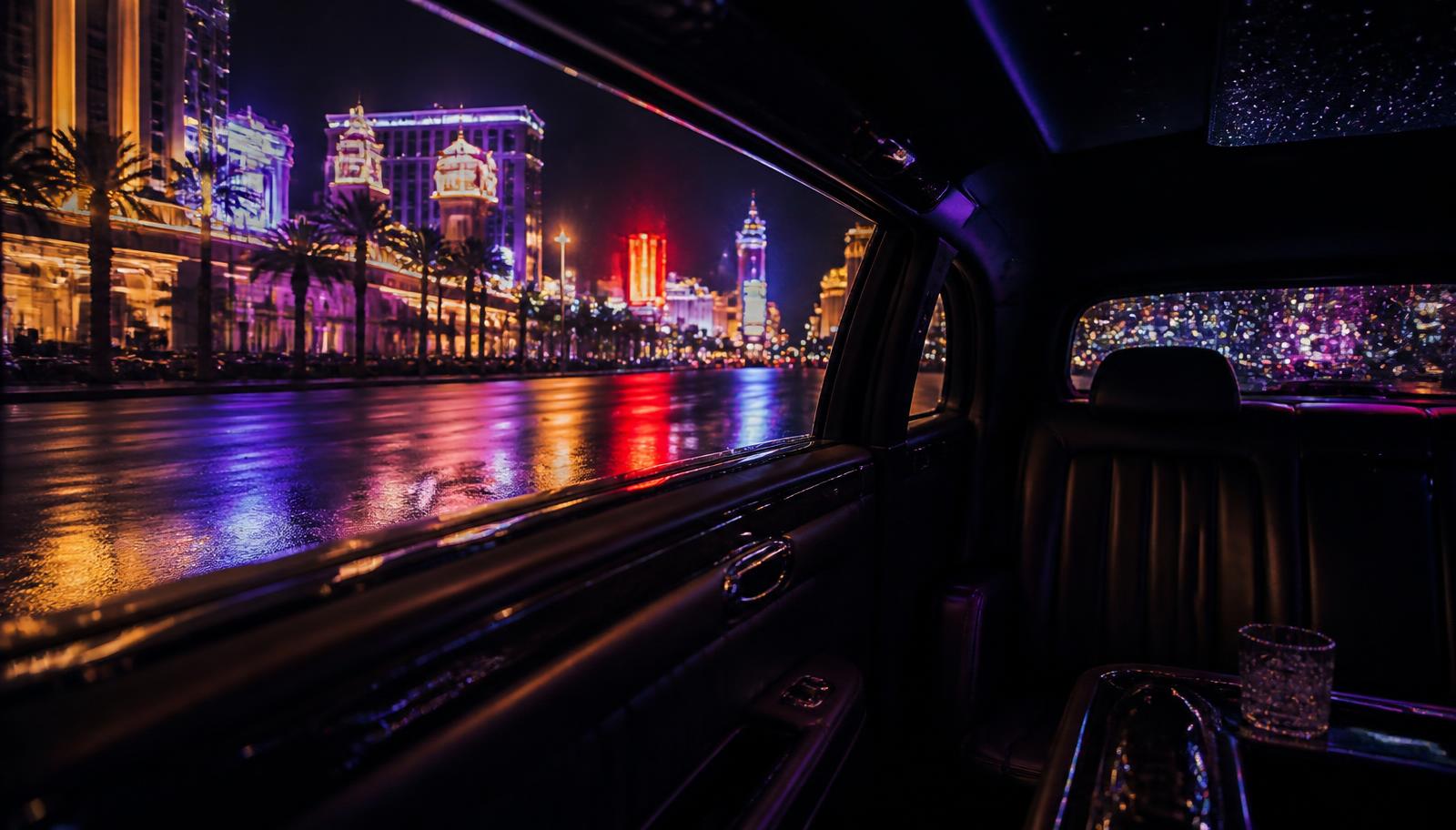
Ask most visitors what happens in Las Vegas after midnight and you will get an answer built from movies: slow motion, champagne, a soundtrack. Ask someone who drives the Strip for a living and the answer is quieter and stranger. After midnight the city stops performing for the cameras and starts behaving like a place where several hundred thousand people are awake at once, each of them somewhere in the middle of a decision. From the driver's seat, that is the real story of the night — not spectacle, but people.
That perspective is the whole reason the Limo Driver series exists. Aleksandar Saber spent his working nights behind the wheel of a limousine in Las Vegas, and the books collect what that job showed him. This article is an introduction to that point of view rather than a retelling of the stories themselves. The stories belong in the book, where they can be told properly, at length, and in the order they happened.
The city changes shape after midnight
Las Vegas after midnight is a different city from the one on the postcards. The daytime version is a schedule: check-in, buffet, pool, show. The late version has no schedule at all. Traffic thins out and then thickens again in odd bursts. The boulevard's neon looks brighter because there is less daylight competing with it, and the same signs that felt like advertising at noon start to feel like weather. Wet asphalt, when it rains, turns the whole street into a second set of lights lying flat on the ground.
A driver notices these things because a driver is stationary inside a moving night. The city arrives at the car in ten- and twenty-minute pieces. Someone gets in, the door closes, and for the length of a ride you are the only two people in a private room travelling at forty miles an hour through the loudest street in America. That combination — enclosed, temporary, anonymous — is what makes people talk.
Why passengers tell a driver the truth
There is a particular kind of honesty that only exists between strangers who will not meet again. In the back seat, no one is being judged by a colleague, a spouse, or an old friend who remembers who they used to be. The driver has no stake in the outcome, no history to compare against, and no reason to repeat any of it at breakfast. People sense that immediately, and some of them use it.
So the conversation goes somewhere it would never go in daylight. Some passengers celebrate loudly and then go quiet at a red light. Some rehearse what they are about to say to someone waiting at the other end of the ride. Some are on their way to something they have saved years for, and some are on the way back from it. The mirror shows all of it, and a driver learns very quickly that the volume of a night has almost nothing to do with its weight.
That is where the phrase "true stories" earns its place on the cover. The Limo Driver series is not a collection of invented Vegas mythology. It is what one working driver saw and heard, written down.
The man behind the wheel came from somewhere else
The free chapter of the first book, "Who I Am," makes something clear before a single passenger appears: the driver was an outsider too. Aleksandar Saber was born and raised in Serbia, where, as he writes, life teaches you early that nothing worth having comes easily. Hard work was not admired so much as assumed. If you wanted something, you earned it. If you gave your word, you kept it. If life knocked you down, you stood back up, because there was no alternative.
He came to the United States because of a relationship that began in Serbia and grew into a decision to build a life together. He packed what he owned into a few suitcases and left everything familiar behind — the streets, the language, the people, the sense of knowing exactly where you belong. He describes the ordinary things that suddenly become difficult: buying groceries, opening a bank account, filling out paperwork, asking for directions. And he describes what immigrants carry that makes those things survivable, which is hope — the thing that quietly argues tomorrow can be better than today.
None of that was a plan to become a limousine driver, and certainly not a plan to write a book. Las Vegas was not on his mind. The job came first; the stories came because of the job.
What the back seat actually teaches you
Drive enough nights and the city stops being a destination and becomes a cross-section. The same vehicle that carries someone to the best night of their life carries someone else away from the worst one, sometimes within the same hour. You start to see how thin the line is between the two, and how little the Strip's lighting cares which side of it you are on.
That is also why so many people assume the stories must be invented. They sound too improbable to be real. The honest answer is the one Saber gives: he did not invent them. Las Vegas did. A city built to concentrate luck, money, ambition and regret into a few square miles will produce coincidences that no novelist would risk putting on the page.
Where to start reading
"Stories From the Driver's Seat" is where we publish pieces like this one — context, atmosphere and background for the series. The stories themselves live in the books. The Limousine Driver: True Stories from the Back Seat of Las Vegas is available now as an eBook, published by Saber IQ LLC.
The best way to decide whether this is your kind of book is simply to read some of it. Chapter One is free, with no account required, in a distraction-free reading room with adjustable type and light, sepia and dark modes. If it holds you, the complete eBook is a few dollars and one click away, and it lands in your library immediately.